Invoking Azure Functions from AL

  • Reading time:5 mins read

One elegant way of replacing your .NET interoperability code with something else is by using Azure Functions. Sounds good in theory, but what does it take in practice? And what are Azure Functions, anyway?

Let me not take too much latitude, and let me just say that Azure Functions are a way of running simple pieces of code as a service that you can invoke like any other RESTful web services. And of course, they run in Azure. To learn more about them, follow this link: https://docs.microsoft.com/en-us/azure/azure-functions/functions-overview

Creating them is as simple, as invoking them, so let’s get started with an extremely simple demo that will illustrate how amazingly powerful they are, and why they are a perfect solution for replacing your .NET code with something better.
Continue ReadingInvoking Azure Functions from AL

NAV performance part 3: Azure VM configurations

  • Reading time:7 mins read

While NAV has traditionally mostly been a domestic animal, it’s now getting pushed more and more cloudwards. A large number of partners and customers are considering Azure VMs as their platform of choice as it has many benefits over purchasing and running the whole show in your own basement.

So, I have tested several Azure VM configurations to show what A, D, and G tiers bring to the show, and how much those numbers next to tier letters really mean.

These were the contestants:

  • A2
  • A7
  • D2
  • DS13
  • GS3

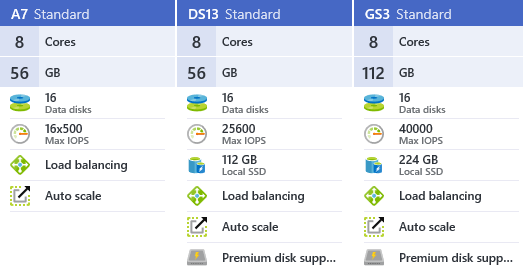
I chose A7, DS13 and GS3 because they all have fairly similar resources:

image

The only significant difference here is that DS13 and GS3 use premium disks, while A7 uses standard disks, however there is also some difference in hardware configurations. G tier has much better processors than D tier, which has better processors than A tier.

The other two contestants are somewhat undersized and I used them to check if those configurations can cope with sustained pressure:

image

And, there is an unexpected guest in this roundup: the DS13 machine with SQL Azure P11. It’s an oversized and unbelievably expensive options, and the reason why I put it here is that it’s the only SQL Azure configuration that can remotely hope to compete with VM deployments of SQL.

Let’s see the results.

Continue ReadingNAV performance part 3: Azure VM configurations

NAV performance in various configurations

  • Reading time:8 mins read

Yes, I have been a lazy blogger lately. With so many people blogging about NAV nowadays, it’s really difficult to come up with original content all the time.

Let venture a little bit out of my .NET and JavaScript comfort zone, and hang around a more formidable beast: SQL. And as you know, SQL comes in many shapes. It comes in shape of your rack server, or in shape of your laptop. But it also comes in shape of clouds. Many clouds.

So, I decided to test performance of NAV under various configurations, including on-prem, Azure VM and SQL Azure, and share my findings with you. And while I am writing these lines, there are four machines sweating the crap out under some performance test code I recently wrote.

Continue ReadingNAV performance in various configurations

NavUserAccountHelper class

  • Reading time:3 mins read

Even though my blog queue has a lot of far more interesting todo entries waiting for their prime time, on my short flight to the Directions EMEA conference in Poznań, instead of dozing away or blank-staring through the window, I’ve decided to introduce the Microsoft.Dynamics.Nav.NavUserAccount.NavUserAccountHelper class, a part of the built-in .NET stack of Microsoft Dynamics NAV since the version 2013 R2. My friend, Eric, asked me to blog about it, so here it is, this post is for you, Eric.

Continue ReadingNavUserAccountHelper class

Can Microsoft Dynamics ERP move to the cloud?

  • Reading time:3 mins read

imageThe Software Advice blog has started a series of short five minute interviews with Microsoft executives in charge of Dynamics technologies, and today’s one has caught my attention: it’s entitled Can Microsoft Dynamics ERP move to the cloud, and the interview was with Guy Weismantel, director of ERP Marketing at Microsoft.

Cloud computing is something that has been tickling my imagination ever since I first heard the term, and I’ve spent past couple of years not only thinking how to do something with the cloud, but actually doing it (stay tuned!), so it was interesting to see what’s Microsoft’s unofficial official position on ERP in cloud perspective, can it be done, should it be done, where is it all going, etc.

Continue ReadingCan Microsoft Dynamics ERP move to the cloud?

A look back: February 2009

  • Reading time:7 mins read

Another month is over, and in my recently established tradition, I’m taking a look back at the past month to give you an overview of developments around NavigateIntoSuccess.com.

This was both a great month, and a rough month for me. Rough, because I had terrible hosting issues, and great because in spite of that, you visited this blog regularly and engaged in discussions more than ever before. Thanks!

So, let’s take a short overview of what this blog did in February 2009.

Continue ReadingA look back: February 2009

Associazione Marittima di Sabioncello

  • Reading time:5 mins read

A short story about maritime trading, steamboats and Microsoft’s Azure Services Platform in short to mid-term ERP and Microsoft Dynamics NAV perspective

Barque "Eber", AMS, 1870 This is a story of a business which failed, and it didn’t have to. It had all the capital and resources it needed to grow, it held a solid share in an expanding market. And yet, they failed.

Associazione Marittima di Sabioncello (AMS), or Maritime Society of Pelješac, was a shipping company founded in 1865 in Orebić, a small coastal town of southern Croatia. They grew to a fleet of 33 sailing ships, they shipped worldwide, their business expanded so much that eventually they built their own shipyard. Allegedly, they were one of the biggest and most prosperous maritime merchant companies in the Mediterranean.

And then an innovation came along, which ruined them.

Continue ReadingAssociazione Marittima di Sabioncello