Better late than never: NAV TechDays 2016 goodies

  • Reading time:1 min read

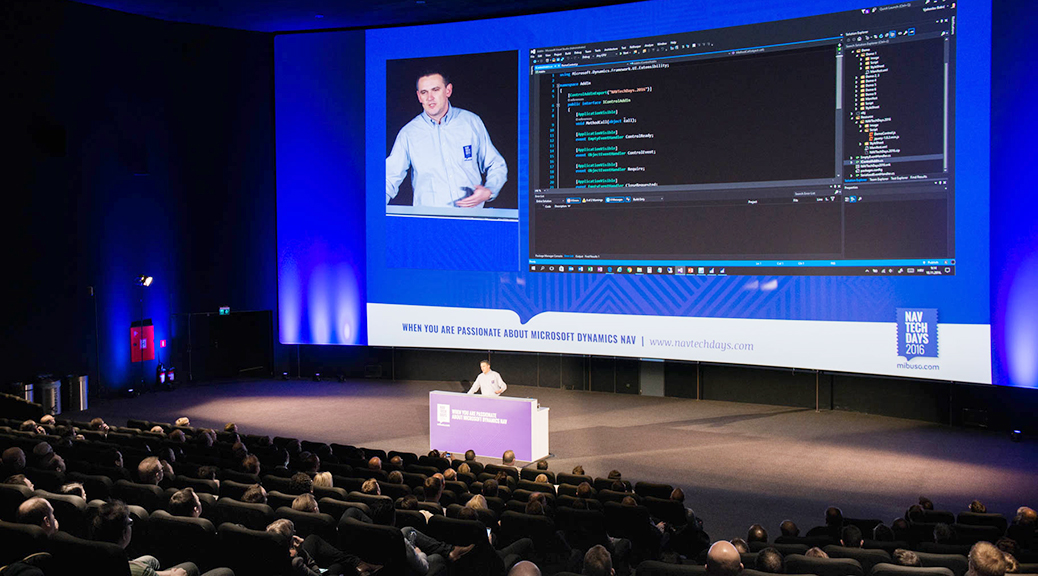
This year my work got a better of me. For five years in a row I have posted all my demos and materials from NAV TechDays sessions right after them. However, this year, I failed. And I apologize for this.

But, as the saying goes, good things come to those who wait, and here it is – all the materials from my “JavaScript Architecture: Turning Pain into Gain” session are here.

Continue ReadingBetter late than never: NAV TechDays 2016 goodies

HelloWorld.al

  • Reading time:2 mins read

Finally. Not quite, but still – finally! We finally get the first public glimpse of future of AL code writing, courtesy of Microsoft Dynamics NAV development team.

As you might know, Microsoft is working around the clock to enable new kind of programming for NAV: using Visual Studio Code instead of Microsoft Dynamics NAV Development Environment. They announced it with due fanfare at Directions US, Directions EMEA, and NAV TechDays, and now the NAV community is biting their fingernails off waiting for Microsoft to actually release the thing.

They said some kind of preview will be made somewhat available sometime in December this year, but for now we have got the first glimpse of the new AL syntax.

Continue ReadingHelloWorld.al

C/AL internals: Some more invalid object states

  • Reading time:6 mins read

If you have followed the posts about how C/AL really executes in NAV, you know that C# and C/AL can sometimes be in a state where C/AL compiles, but C# does not, causing you some headaches during run time.

However, what might not be obvious is that there are situations where C/AL does not compile anymore (typically due to a changed dependency signature, or due to an object that went AWOL) but C# not only compiles, but also happily runs as if nothing is wrong in the first place.

These situations can be confusing, and after having read my original post, my friend Heinz has pointed out to those situations and asked me if I can explain them. So, here it goes.

Continue ReadingC/AL internals: Some more invalid object states

C# Injection: Don’t trust FOB

  • Reading time:3 mins read

FOBs, those pesky little files that we all take for granted, import into our databases, and live happily ever after. After you read this post, you’ll handle FOB files very, very carefully.

Why is that? Well, if you haven’t already, then read this post first: From C/AL to executable: how NAV runs your C/AL code

Good, now that we are on the same page, let me explain why you must never, ever, ever trust a FOB file.

Continue ReadingC# Injection: Don’t trust FOB

Quick Tip: Extension Demo Data

  • Reading time:2 mins read

Extensions are a hot topic these days. There was a ton of sessions at both Directions events, likely also at NAVUG, and most of the talks you could hear while mingling around was extensions this, extensions that.

Chances are – you are going to be writing your extensions in a foreseeable future.

However, there is a catch with extensions – while it may be easy to load them up into an environment, unlike Cronus database your extensions must populate the database with their own demo or starter data. Otherwise, they will be pretty much useless.

Continue ReadingQuick Tip: Extension Demo Data
Read more about the article Module Binder Pattern proposal
Zlata Praha, by Roman Boed

Module Binder Pattern proposal

  • Reading time:17 mins read

Whoa! This has been quite an event, the Directions EMEA 2016 in Prague. There has never been this many people (1.700+) and it was quite a pleasure connecting again with old friends, and meeting new friends. Also, it has been quite a pleasure listening to many good sessions, and an even bigger pleasure delivering four of them.

And this is why I am blogging now – to follow up on my promise during my Polymorphic Event Patterns for C/AL. I promised you that I’d post my pattern proposal online, and here I am doing it.

Let’s get started.

Continue ReadingModule Binder Pattern proposal

From C/AL to executable: how NAV runs your C/AL code

  • Reading time:10 mins read

A lot of folks write C/AL and never worry about what happens then. C/AL is written, NAV execute is, the story ends. The same way the story ends when you flush a toilet and the tank refills. How exactly? Who cares.

While understanding the inner workings of a toilet flush tank doesn’t necessarily make you more efficient at whatever it was that made you press the flush button in the first place, having a better understanding of exactly how NAV uses your C/AL code throughout its lifecycle is of arguably higher practical value.

Have you ever wondered what exactly happens to your C/AL code when you write it? How exactly does NAV run that stuff? Does it do any run-time interpretation, or does it compile C/AL into native code that runs on a processor? What does just-in-time compilation  mean and does it happen with C/AL? If so, when and why?

If any of these questions bother you, read on. If they don’t bother you, read on because they should bother you. If they don’t bother you because you know the answers, read on still, and then brag by poking holes in my explanation.

Continue ReadingFrom C/AL to executable: how NAV runs your C/AL code

I had a dream: codeunit references

  • Reading time:7 mins read

Polymorphism is a great thing. .NET, Java, C++ and other folks have enjoyed its benefits for a long time, some more than a quarter century already. Meanwhile, we, the meager C/AL bunch, can only dream about it and draft our little patterns that all come short of it if only by a tiny bit.

Sometimes it feels like writing code with a chalk on a blackboard. There may be no end to your imagination, but there is a very real end to what the board can do for you.

But dream we can. And let me have another dream.

Continue ReadingI had a dream: codeunit references

Gentlemen’s agreement pattern, or handling the “Handled” pattern

  • Reading time:11 mins read

I’ve delved deep into design patterns story with my last two blog posts, but I am far from over. The patterns I discussed are the ones we could use up until NAV 2015 (we can still use them, of course!) but some more robust loose coupling (excuse the near-oxymoron) can be achieved with what NAV 2016 brought along: events.

It’s the “Handled” pattern. This pattern comes from Thomas Hejlsberg, a chief architect and CTO of Microsoft Dynamics NAV, and was first described by Mark Brummel on his blog. It’s a powerful loose-coupling pattern that successfully addresses the shortcomings of all design patterns I discussed earlier. I would prefer calling this pattern Event Façade rather than “Handled”, but it’s not my baby to christen.

Let’s take a look.

Continue ReadingGentlemen’s agreement pattern, or handling the “Handled” pattern

TempBlob Façade: a pattern proposition

  • Reading time:7 mins read

Achieving some kind of polymorphism in C/AL has always been a problem. The fact that true polymorphism with pure C/AL is outright impossible has not stopped the more stubborn of us to at least give it a try. That’s how some cool patterns emerged.

The façade pattern has been evangelized by Gary Winter so eagerly that he couldn’t find time to formally describe it. The other pattern that comes close is the variant façade pattern. It was formally described at the patterns Wiki page, but – to the best of my knowledge – was first figured out by Arend-Jan Kauffmann.

These two patterns can go a long way. No, they are not coming anywhere near true polymorphism, but will achieve some cool loose binding when you need it.

In my practice, I took a step further, and I think it’s about time I share it. Let’s see if it works for you as well as it did for me.

Continue ReadingTempBlob Façade: a pattern proposition