
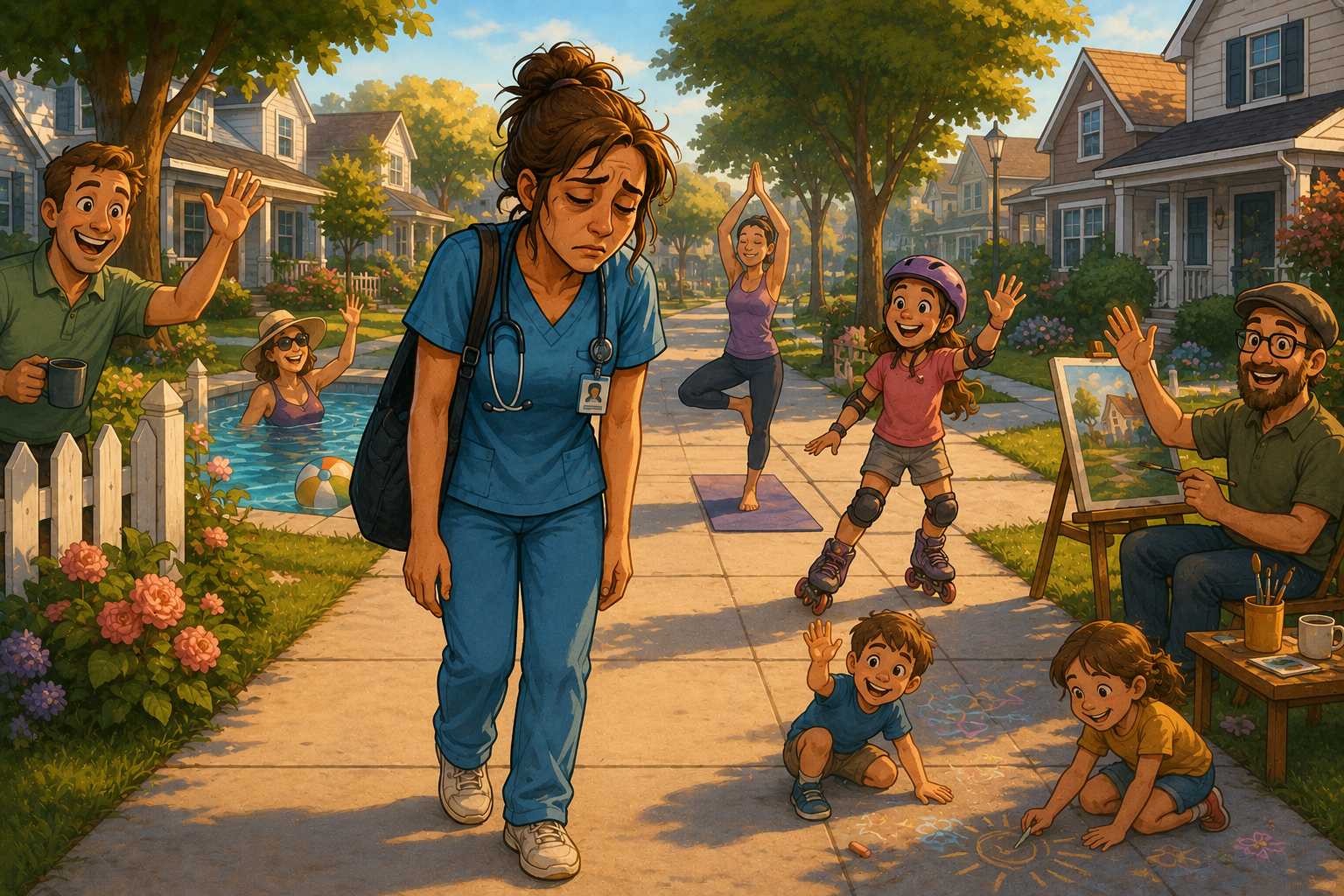
I have a friend who is a nurse. Not the TV kind, with good lighting and a romance subplot. The real kind. She does twelve-hour shifts, she lifts grown men who cannot lift themselves, she cleans up things you and I would rather not put into words, and she holds the hand of someone who is dying while their family is stuck in traffic. Then she goes home, sleeps badly, and does it again. Nights, weekends, Christmas.
Lately everybody is telling me she is going to be fine. Because of UBI.
You know the story by now. AI eats the white-collar jobs first: the programmers, the consultants, the accountants, the analysts, the whole army of people who move information around for living. And once that happens, the answer is supposedly obvious: Universal Basic Income. The machines do the work, the wealth gets redistributed, everyone gets a check, and we all go off (and I’m quoting Sam Altman‘s essay Moore’s Law for Everything here) to “spend more time with people they care about, care for people, appreciate art and nature, or work toward social good”. He even puts a number on it: about $13,500 a year for every adult in the US, paid for by taxing capital instead of labor.
Sounds nice. Sounds humane, even. And I think it’s broken at the core, and the crack runs straight through my friend the nurse.
AI is very good at a lot of jobs we used to call good jobs. And yes, it’s also good at a lot of bad ones: the call-center seat, the data entry, the bookkeeping nobody loved. But the work it cannot touch is suspiciously concentrated at one end. It cannot empty a bedpan. It cannot calm a frightened child in an ER at 3 AM. It cannot clear a blocked sewer pipe, fix your boiler, wire your house, clean the staircase. Maybe the robots get there eventually. Maybe. But the gap between when the spreadsheet job dies and when the bedpan job dies is measured in decades, not Tuesdays. For one whole working life, somebody human will still have to do the grim stuff.
Now here’s where the believer stops me. “But UBI is universal“, they say. “The nurse gets the exact same check as the ex-programmer. Nobody’s excluding her”. Correct. And that’s precisely where the trap awaits.
Because if she gets the same check, she is exactly as free to quit as everybody else. So she stands there at 3 AM, up to her elbows in someone else’s worst day, and she does the math. The ex-programmer next door is learning watercolors. The ex-consultant is doing yoga at 11 in the morning. The ex-accountant finally wrote his novel, God help us all. Why does she have to keep putting up with the stuff nobody else wants to touch with a remote control?
Call me blind, but I see only two ways this can end. Either she keeps showing up because she can’t just walk out on a dying patient. Or she does the perfectly rational thing the check explicitly permits: hangs up the scrubs, and goes home to paint. And then who bags the soiled linens? Who wipes up the vomit? Nobody. Until we make it worth her while again. Which marches us straight back into the problem we are trying to solve in the first place.
“So pay her more!”, you say. Pay nurses double! Heck, pay them triple! Let the market sort it out. And yes, fine, I’ll give you that one: the same tax on capital that funds everyone’s check can fund her raise too. The money is there. But look very carefully at what we just did. UBI was sold to us as the end of working-to-eat, the great decoupling of survival from labor, so nobody on Earth is ever again forced into job just to live. And the very first thing we do, the instant the dust settles, is dangle a fat paycheck to keep the nurse doing the one job nobody else wants to do anymore. For her, and people like her, we quietly switch the old machine back on. Everyone else gets liberation. She gets a… bribe, if we’re honest, to keep doing the worst work in the building. Yes, she ends up making more money than the ex-programmer next door, but she is the only one on the whole street who still has to earn it. That’s far from universal freedom.
And don’t bet the bribe is even as fat as the fairy tale needs it to be. David Graeber formulated a cruel little law that the more obviously useful your work is to other people, the less you tend to get paid for it. Corona crisis made it naked. We called these people “essential”, clapped to them from balconies, and kept paying them peanuts. The optimist has an answer ready, of course: once nobody is desperate, the nasty jobs must beg for workers, so pay them properly! Fine. But this only works where the world can let the job stay empty. The nurse, unfortunately, is the kind of worker whose “no” the society cannot accept. This freedom would never be universal. It would be borrowed, from the nurse and the others who could not be allowed to walk away.
Now, all of that is theory, my theory, for the better part. But what does hard evidence say? Next to nothing. Three countries actually tried a version of this: Finland, Mongolia, and Iran. And not one of them proved a thing. Too small, too short, or simply gone broke before they could tell us anything. Nobody has run an experiment that would settle it: everybody, freed, forever, all at once. The man who bet biggest on UBI, Sam Altman, who championed it and then sank $14 million of his own money into a $60-million, three-year cash experiment, came out the other side: “I no longer believe in universal basic income as much as I once did”. When the man who used to sell a dream stops buying it himself, you pay attention.
But forget for a moment whether it even works. Follow the money instead. UBI runs on the rents from AI and those rents pool in a handful of places: the few countries that build the stuff, and the rich ones that buy the stuff and tax it at home. Everybody else gets nothing to hand out. No AI industry to milk. No fat capital to tax. And, as a cherry on top, the cheap-labor ladder they were busy climbing just got automated out from under them. So UBI doesn’t abolish inequality. It multiplies it, then freezes it into the map: a few post-scarcity islands where citizens are paid just to exist, and the rest of the planet written off. That kind of a gap between nations we have never seen in our entire history.
The clever people have an answer for this too, of course: make the dividend global. Tax the whole AI windfall, share it with all of humanity. Beautiful. Good luck with that. Sure enough, the United States and China are going to tax their golden geese and wire the proceeds to everybody else, with compliments? Makes for an awesome kindergarten picture book. Whoever owns the machines owns the money, and they are nobody’s charity. The check stops at the border.
So zoom in to one street or out to the whole planet, it simply cannot work. They call it universal. But the nurse still works while her neighbors paint, and whole countries struggle while a lucky few are paid to exist. A world built like that is no utopia. It’s a powder keg with a smiley face painted on it.

You are painting a very grim picture here. But it is hard to disagree with your version of the future. UBI is not an answer because there is no ‘universal human’. We all differ, have own desires, goals, talents.
All kind of socialisms and communisms failed because, sooner or later, these systems had to restore to coercion and dictature and finally violence to tame people with dreams and talents. Dictature of one or dictature of ‘ruling class’ – whether overlords are called in singular forms or plural – the common emerging trait is the same – loss of freedom for everyone below.
And UBI is just that – a communism in plain form, dressed in different label.
These ideas fails because they assume that people that run and operate in capitalism are inherently bad – greedy, selfish. Yet the same people when operating in socialism or communism somehow miracuously become good and altruistic.
You are spot on UBI will not abolish inequality. It will amplify it and will polarise differences even more – small group of people owning everything, a bit bigger group of people who protect those on the top – well paid and loyal, and everybody else.
This is not a fantasy. You and me come from contries where this scenario was a history.
I am not even sure if ‘was’ is correct tense…
Is there a viable method preventing this grim future to come true? Sadly, personally I cannot see any.
Neither can I. But in case anyone wonders why billionaires are building bunkers in remote places, I guess it’s becoming obvious 😂
Two thoughts:
1) The long term optimists are expecting robotics + AI to allow the idea of UBI for manual laborers such as your nurse. They would argue the potentiel societal impact you are describing as temporary transitioning downsides until things stabilize in a new paradigm. And i think they would all admit that when big shifts happen in society there are always a lot of people who lose out, mostly those that are unprepared and unwilling to change.
The biggest long term point of discussion is whether or not the world will transition to a post-capitalism society in a way that favors the few or the many. Google “permanent underclass”, if you haven’t read about those ideas.
2) If you are confidently pessimistic, even long term, why are you professionally contributing towards accelerating this future? Are you justifying that mentally by saying “if I didn’t do it, someone else would” ?
1) Yes, I am expecting robotics, too. I am quite optimistic about it. There would be no problem with UBI if everyone gets to be replaced all at the same time. But we are seeing massive asymmetry here: white collar is going to get replaced sooner than blue collar. If it’s a few months, then fine, but it will be years. We see AI already biting into white collar job market; we don’t see it biting as much into blue collar one. I honestly believe that the world will have to transition into post-capitalism. What’s the point of money if you don’t earn it but you get to spend it? In theory, it would probably be just better to fully automate production of commodities, and then there is no need for economy as we know it. I say “probably” because anyone can poke holes in that suggestion, just like I am poking holes in UBI, and you are poking holes in my argument.
2) I am not pessimistic. Or confidently pessimistic. I don’t understany why everyone thinks that if you are talking about bad consequences, you are automatically a pessimist. What I am is this: I am standing there, looking at a big massive rock that’s falling from the sky, and there are people standing underneath, and all I am doing is telling them “look at this rock, it’s gonna fall on your heads unless you do something”. That’s not pessimism, that’s just realism. Now, whether that “realism” is real, whether I imagine things, maybe it’s a rock-shaped, rock-colored balloon floating over, maybe it’s a rock-shaped sponge, maybe it’s whatever else, maybe I am just totally wrong. But then maybe I am not. Who knows? Time will tell. Still, if you saw a rock hovering above your head, a better reaction is to move, rather than keep standing, at least until you figure out is it really a rock, or a sponge. That’s all I am doing. I am contributing towards progress. AI is progress. I don’t see AI as an evil force. I don’t believe in SkyNet (maybe here I am seeing a sponge where there is a real rock, some Nobel-prize winners say that a type of Skynet is coming after all). But in a way, yes, I see AI as an inevitable force, as a force of evolution if you want. AI can do a lot of good stuff. One good consequence would indeed be that we don’t have to labor hard only to be able to live, especially where you are laboring your ass of for 45 years, and then retire into poverty, and then die out of oblivion three years later. I’d rather spend 45 years, or at least those 15 years that I’d still have to labor until I get to retire, doing something better than laboring my ass off. The reason why I am contributing is because I am not naive. Every tool in the history has displaced or replaced some kind of work. If you were a hunter 400.000 years ago and were hunting by throwing rocks, you were displaced by a spear. Also 70.000 years ago if you were still hunting with a spear, you were displaced by bow and arrow. Hunters who adopted spear, then bow and arrow were more efficient. Of course, if there was enough game to hunt, you’d still be fine, but once there is not enough game available, if you don’t adopt, you die. I am also not a luddite, and while I see AI as a threat, I don’t see it as a negative force. It’s only a threat if we aren’t ready. And we aren’t ready. The only thing I want to achieve is make people ready as much as I can, from where I stand. Just that.