Microsoft releases Sure Step 2012

  • Reading time:9 mins read

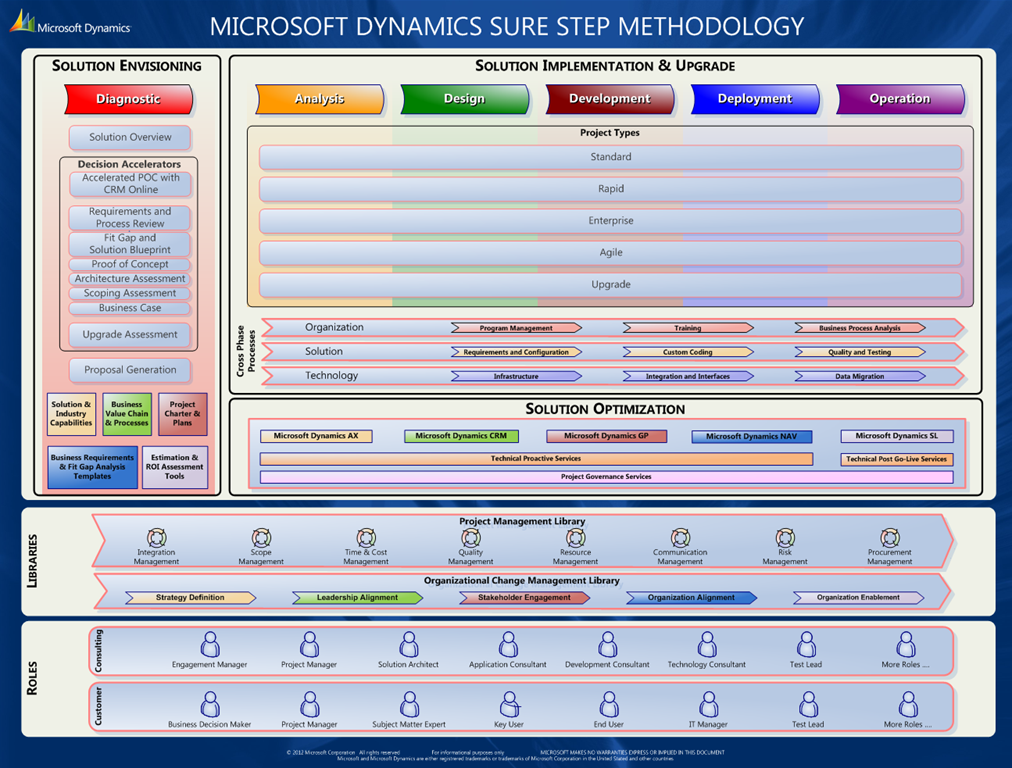
imageA couple of days ago, at a Sure Step 2010 training at Sundsgården, Helsingborg, Sweden, while students were preparing to take the exam, one of the students asks me where she can download Sure Step 2010. I give her the link, but she tells me: “No, that’s Sure Step 2012, I’d like to download 2010”.

That came as a surprise. “No way” – I say – “It hasn’t yet been released.”

Or has it?

And then I check, and almost can’t believe it – it’s really there. I completely missed the tweets, the Facebook announcement, the LinkedIn discussions. It seems that I’m not particularly social nowadays. A quick check of Twitter shows me that there wasn’t too much buzz around it, and most of the blogosphere simply redelivers the same content, which either comes from the official announcement (which I also missed Smile) or from whoever blogged first.

Instead of giving a simple “excited” redelivery of the announcement, here’s my take on Sure Step 2012, what’s new, what’s not new (both sadly and thankfully).

Continue ReadingMicrosoft releases Sure Step 2012

Sure Step in action: business process change

  • Reading time:5 mins read

Service Providers (or colloquially partners) often refrain from undertaking organization or process changes during implementation projects of Microsoft Dynamics solutions. And it comes as no surprise: there are many risks related to it, and customizations are taken as a more traditional approach.

Customizations are easy to predict, they do come at risk, but at least the risks are known and often easily managed entirely within service provider’s organization and reach, while organizational change is unpredictable, and often exceeds consultants’ knowledge, experience and expertise.

However, with or without intention or consent, organizational change will always happen. No solution has ever been 100% fit, and since the customer must do their business with the solution, the remainder from fit to 100% will always and without exception be satisfied with an unmanaged, unintentional, but evolutionary process change.

Instead of leaving it all to chance, Sure Step offers much better ways.

Continue ReadingSure Step in action: business process change

My new career path – independent consultant

  • Reading time:3 mins read

It’s official now, and it’s time I announce it here: after two years at Microsoft I’ve decided to take the helm of my career and venture into the realm of independent consulting. Two days into it, and all I can say about it is: what have I been waiting for this long?

While at Microsoft, I had a chance to work on some very exciting projects, I was sitting at the source of information, and the thrill of being able to know about all the news and developments before anyone else is priceless.

But the thrill of being able to work on my own, to pick my own projects, to take on completely new challenges, was even more priceless.

Continue ReadingMy new career path – independent consultant

Do you need contingency reserve?

  • Reading time:4 mins read

If projects were completely predictable, there would be no need for risk management. Everything could be planned and executed according to plan. However, we know better. Unexpected things happen, disrupt the original plans and cause time and cost overruns. In IT projects, these overruns are far too common to be ignored.

Continue ReadingDo you need contingency reserve?

What’s a project plan?

  • Reading time:4 mins read

Project plan. A fancy term we all like to use. But believe it or not, most of us don’t even know what a project plan really is.

I don’t know why, how and when it came to be that in IT we started using the term project plan, but whatever the origin, the term we use is somewhat incorrect, and when attached to what we often attach it to, it’s downright wrong.

Continue ReadingWhat’s a project plan?

Hollywood Secrets of Project Management Success: a review of a sort

  • Reading time:5 mins read

Hollywood Secrets of Project Management SuccessTake that project you are currently running, and imagine, just for a second, that it came with only 3% budget overrun. Most of people in software industry would call it wild success.

In motion picture industry, however, trampling measly 2% or 3% over initial budget would be considered a failure.

While movie industry and software industry are seemingly light years apart, there are many things these two have in common, and there are obviously many things we can learn from them.

Continue ReadingHollywood Secrets of Project Management Success: a review of a sort

Disruptive nature of ERP projects

  • Reading time:4 mins read

Many project management authorities assert that from project management stance all projects are equal. I dare saying that some projects are more equal than others.

In my last post, I argued why I believe software (and ERP) projects are different. But something came to my mind today, and it’s really an important differentiator of ERP projects from other kinds of projects.

Continue ReadingDisruptive nature of ERP projects

Is an ERP implementation project just a project?

  • Reading time:5 mins read

image “Software projects are no different from other projects”.

This statement is being repeated over and over at project management courses and seminars, even endorsed in books.

It’s true that software (and ERP implementation, as a subset of software) projects have many traits in common with projects in other disciplines. But ignoring their specifics is almost as wrong as saying that software projects are completely different than other projects.

Continue ReadingIs an ERP implementation project just a project?

How you should learn from Sure Step

  • Reading time:5 mins read

Sword & stone (Excalibur) by Midnight-digital (Not leaving ! Just very busy) (opens in a new window) Prescriptive methodologies, such as Sure Step, are double-edged swords. They are aimed at increasing repeatability, consistency, traceability, manageability and more of your projects, yet they seemingly increase overhead and contribute to an inflated project price tag.

As a result, companies sometimes offer excuses such as: it would be too expensive for the customer, or we would lose the project to the competitor, because our price would be too high.

In my opinion, this kind of reasoning is just wrong.

Continue ReadingHow you should learn from Sure Step

How to prevent failure: project education

  • Reading time:3 mins read

According to Standish Group, top causes of failed IT project are these:

  • lack of end-user engagement,
  • unclear specification,
  • changes in scope,
  • lack of management support,
  • lack of planning,
  • unrealistic and unclear goals.

I haven’t seen too many failed Microsoft Dynamics NAV implementation projects, but those that I did see fail, have failed precisely for a selection of these reasons.

Take a closer look at the list above. Doesn’t it seem that the blame lays mostly on the customer? But is it really customer’s fault?

Continue ReadingHow to prevent failure: project education