Server Extensibility Demos

  • Reading time:1 min read

Yesterday, as a part of Microsoft’s Road To Repeatability program, I delivered a live meeting session about server extensibility in NAV in which I focused on certain areas of .NET Interoperability and Web Services that in my opinion align well with the R2R message.

As promised, here are the materials from the presentation:

I provide this as-is, with no comments, documentation or anything – you are free to use any of these materials in your projects, and I welcome your questions here about presentation content and demos. I’ll do my best to answer them on my earliest convenience.

I hope you enjoyed the presentation yesterday (if you were attending) and that you find these materials useful.

Continue ReadingServer Extensibility Demos

How To Update a Class Or Assembly Reference in C/AL And Retain Event Trigger Code

  • Reading time:3 mins read

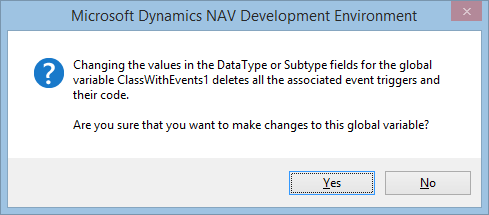
When you reference a .NET class that exposes events, and you switch on the WithEvents property, C/SIDE creates the event triggers for you. If you later want to update the reference to the .NET class, for whatever reason (like, there is a newer version of the assembly), updating the reference will actually delete the event triggers with all the code in them.

To be fair to this non-feature, at least it warns you politely:

image

This is not something you experience once in a geologic era. When you are developing your own assemblies, this will happen fairly often – as often as you add or remove events to/from your classes, and you want to reflect that in the Development Environment. Or as often as you increase the version of your assembly.

Unfortunately, there is no way in the Development Environment to update the reference while actually retaining the event triggers or code in them.

But still, there is a way, and a fairly easy way at that.

Continue ReadingHow To Update a Class Or Assembly Reference in C/AL And Retain Event Trigger Code

Passing JSON from JavaScript to C/AL

  • Reading time:4 mins read

Yesterday, I said I was closing this year of blogging, but I wasn’t really. Closing a year with 39 posts, and leaving a question lingering, wouldn’t be too fair, would it? If you read my last postabout how to pass objects from C/AL to JavaScript, you must have wondered if it’s possible to also pass objects from JavaScript back to C/AL.

Wonder no more. It is. And here’s how.

Continue ReadingPassing JSON from JavaScript to C/AL

The “Life Hack” from today’s Session

  • Reading time:1 min read

And yes, I almost forgot… Somebody (sorry, I didn’t catch the name) asked me to put my life hack on the blog as well, so here it is. For all of you who were not there, I use this as a template for declaring .NET variables – until Microsoft provides means to declare them in a simpler ways. Inline, anyone?

So – download the life hack, or cheat sheet, here: https://vjeko.com/wp-content/uploads/2014/11/Life_Hack_No_1.docx

Continue ReadingThe “Life Hack” from today’s Session

DEmos from the .NET Interop for Mere Mortals

  • Reading time:1 min read

Thanks to everybody who attended my session today at NAV TechDays 2014 in Antwerp. As promised, here are the goodies from the session. I’ve simply taken the objects and I deliver them here with no explanations or comments – when Luc publishes the sessions and the slide decks on Mibuso, you’ll be able to figure out what’s what. I hope you don’t mind.

I’ve also included my demo from the PRS session today, about the Service Locator pattern. The ZIP file does not include the Visual Studio solution – you can find it in my previous post, that I’ve put here yesterday.

I hope you find these examples useful and that they help you get started with .NET Interop quickly.

Download the files here: https://vjeko.com/wp-content/uploads/2014/11/NAVTechDays2014.MereMortals.zip.

Continue ReadingDEmos from the .NET Interop for Mere Mortals

NAV TechDays 2014 Pre-conference goodies

  • Reading time:1 min read

So, NAV TechDays 2014 have started, again, with the pre-conference sessions that were all sold out and packed full.

Today I had an extraordinary pleasure to teach the advanced .NET Interoperability concepts to 15 people that came from all over the world, from Brazil to Australia. It was an interesting workshop, challenging – I must say (thanks to Rafael who made me improvise a solution to a typical DotNet limitation), and I am looking forward to delivering two more sessions about .NET and Control Add-ins tomorrow, and on Friday.

As promised, I am making the materials from the presentation available for the download, in case you want to learn the same stuff the attendees learned today.

Continue ReadingNAV TechDays 2014 Pre-conference goodies

Adding a ControlAddInReady event to custom controls

  • Reading time:4 mins read

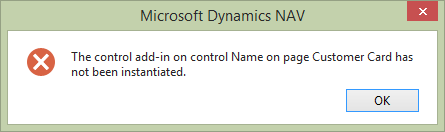
When interacting with custom controls on your pages from C/AL, you must be absolutely sure that the control has been instantiated. If it is not, you’ll get an error such as this:

image

The reason why this happens is that C/AL code gets to execute before the page has been rendered, and thus also before the custom controls have been instantiated.

Continue ReadingAdding a ControlAddInReady event to custom controls

NavUserAccountHelper class

  • Reading time:3 mins read

Even though my blog queue has a lot of far more interesting todo entries waiting for their prime time, on my short flight to the Directions EMEA conference in Poznań, instead of dozing away or blank-staring through the window, I’ve decided to introduce the Microsoft.Dynamics.Nav.NavUserAccount.NavUserAccountHelper class, a part of the built-in .NET stack of Microsoft Dynamics NAV since the version 2013 R2. My friend, Eric, asked me to blog about it, so here it is, this post is for you, Eric.

Continue ReadingNavUserAccountHelper class

Three Whys about .NET Interoperability

  • Reading time:5 mins read

Once upon a time, a smart bloke named Saikichi Toyoda came up with a 5 Whys troubleshooting technique. It postulates that you only need to ask “why” five times to get to the root cause of any problem in a cause-and-effect sequence.

However, with .NET Interoperability in Microsoft Dynamics NAV (pick your version here), I’ve only had to ask “why” three times today, and unfortunately I could not get to the root cause, except – poor design decisions.

It all has to do with a simple .NET class: System.DBNull. The first “why” is simple: why is there no support for fields on .NET types. The second “why” is even simpler: why don’t we have a null constant in C/AL. And the last “why” downright falls into the “what the heck” category: why did somebody think it was a smart idea to replace DBNull value with null.

Continue ReadingThree Whys about .NET Interoperability