Resident control add-ins – no SingleInstance

  • Reading time:10 mins read

My last topic was resident control add-ins. In my video and written blog I’ve explained what they are and how you can quickly have them up and running. However, there was one particular thing I said I generally don’t like – single-instance codeunits. So my second blog on this topic focuses precisely on that: how to make your control add-in available to your AL code from everywhere, without having to rely on a single-instance codeunit.


Continue ReadingResident control add-ins – no SingleInstance

Top 5 things I miss in AL

  • Reading time:9 mins read

The community often criticizes Microsoft for adding new platform features only when Microsoft needed them. Well, it has been a bit too harsh – Microsoft did add improvements in other situations, too. But still, if you compare it to other Microsoft’s languages like TypeScript or C#, the AL language isn’t really advancing.

Looking back at C/AL, the AL language has really brought a lot of improvements. We have native JSON types, HTTP API, interfaces, overloads, and a lot more. But still, the overall change of the AL language was minor improvement, rather than a real evolution that transition to VS Code could have allowed.

Here’s the list of top five things I’d absolutely love to see in AL. And I have strong reasons to believe that all of them would be fairly easy to implement for Microsoft. Let’s get started.

Continue ReadingTop 5 things I miss in AL
Read more about the article Module Binder Pattern proposal
Zlata Praha, by Roman Boed

Module Binder Pattern proposal

  • Reading time:17 mins read

Whoa! This has been quite an event, the Directions EMEA 2016 in Prague. There has never been this many people (1.700+) and it was quite a pleasure connecting again with old friends, and meeting new friends. Also, it has been quite a pleasure listening to many good sessions, and an even bigger pleasure delivering four of them.

And this is why I am blogging now – to follow up on my promise during my Polymorphic Event Patterns for C/AL. I promised you that I’d post my pattern proposal online, and here I am doing it.

Let’s get started.

Continue ReadingModule Binder Pattern proposal

Gentlemen’s agreement pattern, or handling the “Handled” pattern

  • Reading time:11 mins read

I’ve delved deep into design patterns story with my last two blog posts, but I am far from over. The patterns I discussed are the ones we could use up until NAV 2015 (we can still use them, of course!) but some more robust loose coupling (excuse the near-oxymoron) can be achieved with what NAV 2016 brought along: events.

It’s the “Handled” pattern. This pattern comes from Thomas Hejlsberg, a chief architect and CTO of Microsoft Dynamics NAV, and was first described by Mark Brummel on his blog. It’s a powerful loose-coupling pattern that successfully addresses the shortcomings of all design patterns I discussed earlier. I would prefer calling this pattern Event Façade rather than “Handled”, but it’s not my baby to christen.

Let’s take a look.

Continue ReadingGentlemen’s agreement pattern, or handling the “Handled” pattern

TempBlob Façade: a pattern proposition

  • Reading time:7 mins read

Achieving some kind of polymorphism in C/AL has always been a problem. The fact that true polymorphism with pure C/AL is outright impossible has not stopped the more stubborn of us to at least give it a try. That’s how some cool patterns emerged.

The façade pattern has been evangelized by Gary Winter so eagerly that he couldn’t find time to formally describe it. The other pattern that comes close is the variant façade pattern. It was formally described at the patterns Wiki page, but – to the best of my knowledge – was first figured out by Arend-Jan Kauffmann.

These two patterns can go a long way. No, they are not coming anywhere near true polymorphism, but will achieve some cool loose binding when you need it.

In my practice, I took a step further, and I think it’s about time I share it. Let’s see if it works for you as well as it did for me.

Continue ReadingTempBlob Façade: a pattern proposition

OnAfter table event subscriber patterns and antipatterns

  • Reading time:6 mins read

The purpose of events is to simplify business logic customization while not impeding upgradeability and general extensibility. However, there is one particular class of events that may cause troubles: OnAfter* table events. There are four of them: OnAfterInsert, OnAfterModify, OnAfterDelete, and OnAfterRename.

If you need them, you must be careful.

Continue ReadingOnAfter table event subscriber patterns and antipatterns

Dynamically loading assemblies at runtime

  • Reading time:6 mins read

When you spend more time in C# than C/AL, and you still tell yourself and the world around you that you are developing for NAV, then this post is for you.

I already wrote a three-article series about “DLL hell” and how to resolve it, and in my last post in the series (https://vjeko.com/sorting-out-the-dll-hell-part-3-the-code) I delivered some code that help you take control of your .NET assemblies.

This time, I am delivering an updated solution, one that solves all the problems others, and myself, have encountered in the meantime.

So, fasten the seatbelt, and let’s embark on another .NET interoperability black belt ride.

Continue ReadingDynamically loading assemblies at runtime

How To Update a Class Or Assembly Reference in C/AL And Retain Event Trigger Code

  • Reading time:3 mins read

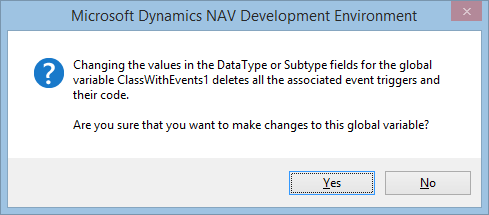
When you reference a .NET class that exposes events, and you switch on the WithEvents property, C/SIDE creates the event triggers for you. If you later want to update the reference to the .NET class, for whatever reason (like, there is a newer version of the assembly), updating the reference will actually delete the event triggers with all the code in them.

To be fair to this non-feature, at least it warns you politely:

image

This is not something you experience once in a geologic era. When you are developing your own assemblies, this will happen fairly often – as often as you add or remove events to/from your classes, and you want to reflect that in the Development Environment. Or as often as you increase the version of your assembly.

Unfortunately, there is no way in the Development Environment to update the reference while actually retaining the event triggers or code in them.

But still, there is a way, and a fairly easy way at that.

Continue ReadingHow To Update a Class Or Assembly Reference in C/AL And Retain Event Trigger Code