How to replace DotNet in AL

  • Reading time:7 mins read

A lot of us still have a ton of C/AL code sitting around in existing databases that sooner or later will have to be moved into AL. A lot of us also have a ton of AL code using DotNet that we want to be able to run in Microsoft’s cloud (that is: not on-prem). And I guess most of us don’t want to maintain a DotNet-less and DotNet-ful versions of our code.

Sooner or later, you’ll want all of DotNet out of your AL. Even if you are a seasoned .NET developer, you’ll want all DotNet out of AL.

Anyway, when you need to replace DotNet, what options do you have? Let’s take a look at all possible paths.

Continue ReadingHow to replace DotNet in AL

State of .NET Affairs

  • Reading time:17 mins read

I said a word or two about progress last week. Apparently, VS Code is not the only place where we take a small step back to be able to make a huge leap forward; .NET might seem like another one.

You know it, right? You know that if you want to run your .NET code in D365 for Financials, you are out of luck, and you do know that this applies to as much to Microsoft .NET Framework out-of-the-box types as it does to your own, custom-built .NET assemblies. If you don’t know that yet, then let me bring you up to date: In your D365 apps built on Extensions “v2” technology, you won’t be able to use anything .NET; you simply won’t be able to compile AL code that includes a DotNet variable declaration.

This is neither fake news, nor is it news per se. It has been known at least since October last year when Microsoft first presented AL Language extension for VS Code during Directions US in Phoenix. Soon after the VS Code session there was a round table (in all honesty, I have never seen a table, let alone a round one, at any of round table sessions at any conference) on the topic of .NET future, and the mood was grim. At first everyone thought it was a bad joke, then all held hopes high that Microsoft is simply “feeling the pulse” to see how the channel would react to such a disturbing change. But soon it became obvious that .NET interoperability is on its way to be gently ushered out of the (relevant) technology stack of NAV and that we should start getting ready for the day when it’s not there anymore.

So, what is the current state of .NET in NAV, what is the future of it, and what can you do about it?

Let’s take them one by one.

Continue ReadingState of .NET Affairs

How To Update a Class Or Assembly Reference in C/AL And Retain Event Trigger Code

  • Reading time:3 mins read

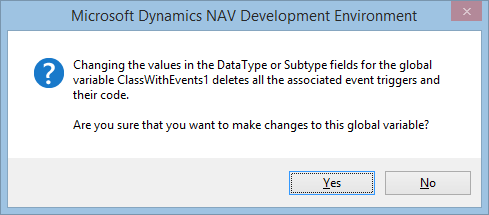
When you reference a .NET class that exposes events, and you switch on the WithEvents property, C/SIDE creates the event triggers for you. If you later want to update the reference to the .NET class, for whatever reason (like, there is a newer version of the assembly), updating the reference will actually delete the event triggers with all the code in them.

To be fair to this non-feature, at least it warns you politely:

image

This is not something you experience once in a geologic era. When you are developing your own assemblies, this will happen fairly often – as often as you add or remove events to/from your classes, and you want to reflect that in the Development Environment. Or as often as you increase the version of your assembly.

Unfortunately, there is no way in the Development Environment to update the reference while actually retaining the event triggers or code in them.

But still, there is a way, and a fairly easy way at that.

Continue ReadingHow To Update a Class Or Assembly Reference in C/AL And Retain Event Trigger Code

The “Life Hack” from today’s Session

  • Reading time:1 min read

And yes, I almost forgot… Somebody (sorry, I didn’t catch the name) asked me to put my life hack on the blog as well, so here it is. For all of you who were not there, I use this as a template for declaring .NET variables – until Microsoft provides means to declare them in a simpler ways. Inline, anyone?

So – download the life hack, or cheat sheet, here: https://vjeko.com/wp-content/uploads/2014/11/Life_Hack_No_1.docx

Continue ReadingThe “Life Hack” from today’s Session

DEmos from the .NET Interop for Mere Mortals

  • Reading time:1 min read

Thanks to everybody who attended my session today at NAV TechDays 2014 in Antwerp. As promised, here are the goodies from the session. I’ve simply taken the objects and I deliver them here with no explanations or comments – when Luc publishes the sessions and the slide decks on Mibuso, you’ll be able to figure out what’s what. I hope you don’t mind.

I’ve also included my demo from the PRS session today, about the Service Locator pattern. The ZIP file does not include the Visual Studio solution – you can find it in my previous post, that I’ve put here yesterday.

I hope you find these examples useful and that they help you get started with .NET Interop quickly.

Download the files here: https://vjeko.com/wp-content/uploads/2014/11/NAVTechDays2014.MereMortals.zip.

Continue ReadingDEmos from the .NET Interop for Mere Mortals

NAV TechDays 2014 Pre-conference goodies

  • Reading time:1 min read

So, NAV TechDays 2014 have started, again, with the pre-conference sessions that were all sold out and packed full.

Today I had an extraordinary pleasure to teach the advanced .NET Interoperability concepts to 15 people that came from all over the world, from Brazil to Australia. It was an interesting workshop, challenging – I must say (thanks to Rafael who made me improvise a solution to a typical DotNet limitation), and I am looking forward to delivering two more sessions about .NET and Control Add-ins tomorrow, and on Friday.

As promised, I am making the materials from the presentation available for the download, in case you want to learn the same stuff the attendees learned today.

Continue ReadingNAV TechDays 2014 Pre-conference goodies

Better error handling in NAV 2015

  • Reading time:3 mins read

You may love C/AL as a language, but there is an area in it that you must just hate. It’s the error handling. Plainly put, and being actually quite positive about it, in NAV, error handling just sucks. If an error happens, it happens. You have only one possibility to actually capture the error, and it’s the IF CODEUNIT.RUN construct, and it’s limited because you can do it only once per transaction, and if you want to do it twice, you must COMMIT your transaction first.

But still, capturing an error is one thing; actually handling it is quite a different thing altogether.

Continue ReadingBetter error handling in NAV 2015

Request page automation in NAV 2015

  • Reading time:5 mins read

Most of What’s New information about NAV 2015 will mostly talk about the Word report layouts, as well as the C/AL support for these. However, most of the What’s New documentation doesn’t have a single word about what I find among the most exciting new reporting features in C/AL: the capability to programmatically control the request pages.

Continue ReadingRequest page automation in NAV 2015

DotNet Quick Tip: Accessing members with invalid names

  • Reading time:2 mins read

A friend asked my by e-mail today about a problem he encountered with DotNet interop: how to access a property of an object, if the property name matches a reserved word in NAV. A simplest example is from the Microsoft.Dynamics.Nav.SMTP.SmtpMessage class that comes bundled with NAV 2013.

Consider this piece of code:

Mail := Mail.SmtpMessage;
Mail.To := 'john.doe@noname.no';

If you try to compile this, it will fail. It’s simple: the To property name is invalid in the C/AL context, because it is a reserved word.

So, how do you fix it?

Continue ReadingDotNet Quick Tip: Accessing members with invalid names

.NET Tips & Tricks: Mediator Pattern (on steroids)

  • Reading time:4 mins read

When I was writing my last post I had a distinct feeling that I was trampling over some boundaries of good NAV design. After all, you should not do stuff like that, NAV isn’t meant to do things like that, or at least that was how I felt.

And then two things happened.

First, I asked myself: what the heck, why not? What exactly is NAV meant to do, and why not things like that? If folks at Vedbæk didn’t provide an out-of-the-box solution for the problem, why should the problem stay unsolved?

Second, my dear friend and a fellow MVP, Hrvoje of Hudo’s Vibe, identified the thing as the mediator pattern. So, the thing I’ve done to NAV, civilized world has been doing to their programming environments for a long time.

And then I decided to take it all to a different level altogether, and expand the simple class which didn’t do much but raise events on itself when its method was called, into a full-scale framework. And here it is, the mediator pattern incarnated into a brand new Dispatcher class, adapted to NAV, and with features that make it truly flexible. I do not dare starting to think what are all the situations where you could put this thing to use in NAV.

Read on.

Continue Reading.NET Tips & Tricks: Mediator Pattern (on steroids)