
Fun with Interfaces

  • Reading time:1 min read

Today I’ve streamed the Fun with Interfaces video blog at https://www.youtube.com/watch?v=QSMHL32c5mg and the recording is now published online.

This was the first session I ever delivered about interfaces, and I actually planned delivering this a lot earlier (I made a suggestion to run this at Directions ASIA before corona crisis hit), but never had a chance. I now polished the demos a bit and delivered it as-is (no slides, really, so – no theory, just practice).

I will have more to say on interfaces, definitely. Stuff like dependency injection, inversion of control, testability, etc. is all very interesting to discuss and very useful in our daily life with AL.

My today’s session not only shows what you can do with interfaces, but also what you cannot, and why. Maybe, who knows, at some point we get some improvements to address some of pain points from my video.

Thanks to everyone who joined me today, and I am looking forward to see all you next week in “Making InvokeExtensibilityMethod work” session.

Continue ReadingFun with Interfaces

How to replace DotNet in AL

  • Reading time:7 mins read

A lot of us still have a ton of C/AL code sitting around in existing databases that sooner or later will have to be moved into AL. A lot of us also have a ton of AL code using DotNet that we want to be able to run in Microsoft’s cloud (that is: not on-prem). And I guess most of us don’t want to maintain a DotNet-less and DotNet-ful versions of our code.

Sooner or later, you’ll want all of DotNet out of your AL. Even if you are a seasoned .NET developer, you’ll want all DotNet out of AL.

Anyway, when you need to replace DotNet, what options do you have? Let’s take a look at all possible paths.

Continue ReadingHow to replace DotNet in AL

Migrating Control Add-ins from C/SIDE to AL

  • Reading time:1 min read

Thanks to everyone who watched my live stream today! The audience wasn’t big, but it’s a very narrow topic, not of broad interest. Still, I am glad I got a few interesting questions that actually introduced my future topics quite nicely.

You can find the recording here:

As promised, I have published the GetImageResource.js file on my GitHub. You can find it here:

https://github.com/vjekob/RandomBits/tree/main/src/js

(There you can also find some usage notes and explanation why you may want to use that file in your control add-ins)

Once again – thanks, and see you next week in a topic that should draw a lot more audience: AL interfaces!

Continue ReadingMigrating Control Add-ins from C/SIDE to AL

Top 5 things I miss in AL

  • Reading time:9 mins read

The community often criticizes Microsoft for adding new platform features only when Microsoft needed them. Well, it has been a bit too harsh – Microsoft did add improvements in other situations, too. But still, if you compare it to other Microsoft’s languages like TypeScript or C#, the AL language isn’t really advancing.

Looking back at C/AL, the AL language has really brought a lot of improvements. We have native JSON types, HTTP API, interfaces, overloads, and a lot more. But still, the overall change of the AL language was minor improvement, rather than a real evolution that transition to VS Code could have allowed.

Here’s the list of top five things I’d absolutely love to see in AL. And I have strong reasons to believe that all of them would be fairly easy to implement for Microsoft. Let’s get started.

Continue ReadingTop 5 things I miss in AL

Code annotations in AL – Please, don’t!

  • Reading time:10 mins read

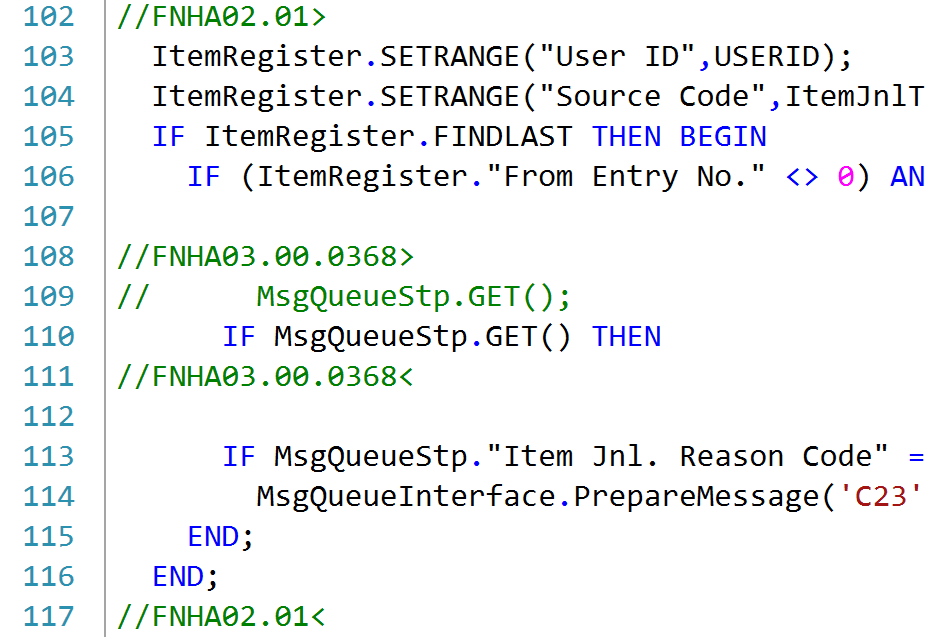
One of good practices of writing C/AL Code for Microsoft Dynamics NAV since the dawn of civilization was annotating (commenting) code changes. If you are not sure what I mean by that, this is what I am talking about:

While standards varied about > vs +, or < vs -, or what the annotations should include, there was absolute consensus that annotating changes is an absolute must.

And it was a must. It was such an important rule that everyone followed it without questions asked. In my career, I’ve seen one or two situations of somebody changing or deleting a line of code without leaving any comment, and I’ve seen quite a lot of code, believe you me. It was that important.

It was that important in fact that it was one of the first things developers learned when they signed up for the job, and it was one of the rules they all followed from their first day.

Continue ReadingCode annotations in AL – Please, don’t!

A couple of AL controladdin demos – Google Maps and Tic Tac Toe

  • Reading time:4 mins read

As a part of preparation for my last event of this year that concludes the conference season 2017 for me, I played around with the latest addition to the AL language stack for VS Code: control add-ins.

If you haven’t already tried it out, or heard about it, then you should get yourself a copy of NAV developer preview, and then visit the Control Add-In Object documentation for AL on MSDN to learn a little bit about how it works. The demo provided over there is, well, basic, to say the least, so I prepared two demos.

Continue ReadingA couple of AL controladdin demos – Google Maps and Tic Tac Toe

Invoking Azure Functions from AL recording available

  • Reading time:1 min read

The “Invoking Azure Functions from AL using Visual Studio Code” webinar is over, and it was a pleasure delivering it for you, folks. There were 350+ people registered for it, and over 200+ people attended it. With those kinds of stats, who wouldn’t want to deliver more of these?

So, I can promise to prepare a couple of more Azure Functions from AL seminars, covering different kinds of topics, including handling binary data, XML, advanced JSON, and similar. Stay tuned.

In the meanwhile, if you didn’t have a chance to watch the session today in prime time, you can access it on YouTube: https://www.youtube.com/watch?v=Wp13-nfVoEg&feature=youtu.be

Thanks to Mark and folks at NAV-Skills and Liberty Grove for making this possible.

Continue ReadingInvoking Azure Functions from AL recording available

Invoking Azure Functions from AL

  • Reading time:5 mins read

One elegant way of replacing your .NET interoperability code with something else is by using Azure Functions. Sounds good in theory, but what does it take in practice? And what are Azure Functions, anyway?

Let me not take too much latitude, and let me just say that Azure Functions are a way of running simple pieces of code as a service that you can invoke like any other RESTful web services. And of course, they run in Azure. To learn more about them, follow this link: https://docs.microsoft.com/en-us/azure/azure-functions/functions-overview

Creating them is as simple, as invoking them, so let’s get started with an extremely simple demo that will illustrate how amazingly powerful they are, and why they are a perfect solution for replacing your .NET code with something better.

Continue ReadingInvoking Azure Functions from AL

Is Visual Studio Code really an improvement

  • Reading time:8 mins read

Progress often doesn’t look like progress at all when it first arrives.

When on July 3, 1886, Daimler Benz presented his first car, it had a 0.75 horse-power engine that could reach a top speed of 16 km/h. It was able to cover 45 km on a single fuel tank, and it could only take two passengers. Compared to best horse-driven carriages of the day, especially taking the availability of stuff you could use as fuel, this was hardly a progress. Horse-driven carriages bested this car on all fronts, and by large margins.

Imagine what the world would look like today should Daimler Benz heeded the naysayers and mockers of his day, and they were not in short supply.

Continue ReadingIs Visual Studio Code really an improvement